California vehicle title transfer - buying, selling & gifts
Transferring a California vehicle title is how ownership officially changes hands - and the two things that trip people up are the deadlines and the tax. The buyer and the seller each have their own clock, and a private sale, a gift, and an inheritance are taxed very differently.
This guide splits the steps by side (buyer vs. seller), lays out each transfer scenario with its form and tax treatment, and covers the fee. The rule to remember: the buyer has 10 days to apply, the seller has 5 days to file the release of liability - and missing either one has a real cost.
Transfer scenarios at a glance
Each path has its own form and tax treatment.
Your steps - buyer vs. seller
The obligations are different depending on which side you're on.
- Get the signed title (pink slip) from the seller, and, if the title has no line for the mileage, a REG 262 (Vehicle/Vessel Transfer & Reassignment) signed by both of you - the DMV mails it on request, as it is printed on security paper
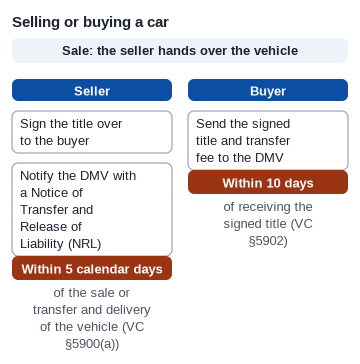
- Apply for the transfer at the DMV within 10 days of receiving the signed title (Vehicle Code §5902); the DMV's private-party page says 10 days after purchasing. The DMV's change-of-ownership page says penalties are assessed if payment is not submitted within 30 days of the sale
- Pay the $15 transfer fee plus any use tax due
- Provide a valid smog certification if the vehicle requires one at change of ownership
- Sign the title over to the buyer and give them a valid smog certification if required
- File a Notice of Transfer and Release of Liability (NRL, form REG 138) within five calendar days - see the release of liability guide
- Filing the NRL ends your liability for what happens with the vehicle after the sale; keep your copy
- A vehicle received as a gift or transferred between certain family members is generally exempt from use tax
- You claim the exemption with a REG 256 (Statement of Facts) - the same form covers estate and inheritance transfers
- Use tax is administered by the CDTFA; the DMV collects it at transfer
View as table
| Who | Step | Deadline | Source wording |
|---|---|---|---|
| Seller | Sign the title over to the buyer | — | Seller/lienholder signs title. |
| Seller | Notify the DMV with a Notice of Transfer and Release of Liability (NRL) | Within 5 calendar days of the sale or transfer and delivery of the vehicle (VC §5900(a)) | You are required by law to notify DMV within 5 calendar days from the date you sell or transfer the title or interest in your vehicle, and deliver possession of the vehicle to another owner. |
| Buyer | Send the signed title and transfer fee to the DMV | Within 10 days of receiving the signed title (VC §5902) | A person who has received, as transferee, a properly endorsed certificate of ownership must within 10 days thereafter forward it with the transfer fee to the department. |
Title transfer fees & tax
A summary of the main fees.
How to transfer a title
The standard buyer flow for a private-party purchase.
How these connect to the rest of the DMV system
Frequently asked questions
Comparison and definitional - to help you pick the right type.
How long do I have to transfer a title after buying a car in California?
What does the seller have to do?
How much is a title transfer in California?
Do I pay use tax on a gift or a transfer from family?
What about a car I inherited?
Do I need a smog check to transfer a title?
I bought from a dealer - do I handle the title?
I lost the title - can I still transfer it?
What is a branded title in California?
What does a salvage certificate mean?
What is a revived salvage vehicle?
Statutes and federal rules cited on this page are our summaries of the text, not quotations; the date each was read is in Sources.
SourcesShow sourcesHide sources11 California DMV pages, 3 other agencies, 2 statutes and federal rules
- Title transfers - checked 2026-11-17
- Registration fees (transfer fee, VC §9255) - checked 2026-11-17
- Notice of Transfer and Release of Liability (NRL) - checked 2026-11-17
- Registering a vehicle from a private party (REG 262 when the title has no mileage line) - checked 2026-11-21
- Registration Procedures Manual §5.025 (odometer disclosure, under 20 model years) - checked 2026-11-20
- How to Change Vehicle Ownership (odometer exemptions) - checked 2026-11-21
- VIN 2021-10, New Odometer Disclosure Requirements (memo, December 8, 2021, PDF) - checked 2026-11-20
- Standard title transfer checklist (PDF) - checked 2026-11-20
- Registering a vehicle from a dealer - checked 2026-11-17
- Total loss salvage & non-repairable vehicles - checked 2026-11-17
- Junk & revived salvage vehicles - checked 2026-11-17
- California CDTFA - Use tax on vehicles - checked 2026-11-17
- California BAR - Smog Check (change-of-ownership exceptions) - checked 2026-11-17
- CDTFA - Use tax on vehicle purchases (Pub. 52: gifts and family) - checked 2026-11-17
- California Vehicle Code §5902 (transfer within 10 days) - read 2026-11-21, our summary
- California Vehicle Code §5900 - read 2026-11-21, our summary